

Learning in Tandem: Designing inclusive, experiential learning at scale
- Management and Organisations
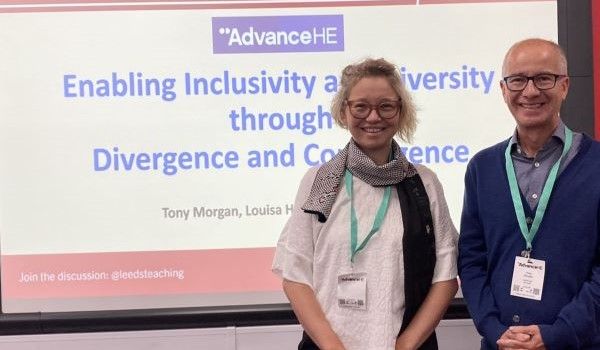
How can universities design team-based learning that is genuinely inclusive, intellectually rigorous and professionally relevant, equipping students with the capabilities they need to thrive in complex professional environments?
At the University of Leeds, our interdisciplinary teaching team (Tony Morgan, Dr Lena Jaspersen, Dr Sanaz Sigaroudi, John Palfreyman and Dr Deirdre Coveney) has spent the past nine years exploring this question through live, challenge-based modules spanning undergraduate, postgraduate and MBA programmes. What began as a collaborative teaching experiment has evolved into a framework now known as Learning in Tandem.
Earlier in this journey, elements of our practice were captured in Design Thinking for Student Projects, which translated our experiential and reflective approach into practical guidance for educators and students. The continued refinement of our work led to the articulation of the broader framework described here.
Although developed within Leeds University Business School, the framework speaks to wider institutional priorities: academic excellence, global engagement, inclusion, and preparing students to thrive in complex professional and societal contexts.
Grounded in research on experiential and authentic learning, and shaped through iterative reflection, the Learning in Tandem model offers a structured yet adaptable approach to collaborative teaching and learning.
Diversity as a foundation for learning
In our own Innovation in Practice modules, diversity is not treated as an add-on. It is the starting point. In contemporary workplaces, graduates rarely operate within homogeneous teams. Designing for interdisciplinary and intercultural collaboration therefore mirrors the realities of modern professional practice.
Our teaching team itself brings together different disciplinary backgrounds, professional experiences and national cultures. Students are deliberately organised into interdisciplinary teams, bringing together perspectives from business, engineering, computing and beyond, alongside varied cultural and educational backgrounds.
Across the University, diversity is one of our greatest strengths. Yet diversity alone does not automatically translate into inclusion or creativity. In our experience, it requires careful design.
Making diversity work: structure, empathy and reflexivity
Two elements have been particularly important.
First, structured diverge–converge methods are embedded into workshops. Students generate ideas individually and in silence (the diverge element) before moving into discussion and collective decision-making (converge aspect). Learning begins with “hopes and fears” conversations, surfacing expectations and concerns early. These routines reduce dominance effects and build psychological safety.
Research on team learning highlights the importance of structured participation and norm-setting in enabling diverse groups to collaborate effectively. Translating this into practical classroom methods has been central to our approach.
Second, reflection and empathy are treated as core academic and professional capabilities. Students complete weekly reflections on collaboration, challenge and growth. Educators engage in structured review of their own practice. Reflection has long been associated with deeper learning and professional development, and here it is integrated as routine rather than retrospective.
This reflexive orientation has allowed the framework itself to evolve.
The Learning in Tandem Framework
Through sustained reflection on practice, feedback and growth, three guiding principles emerged:
- Relationships – Trust-based collaboration across educators, students and partners
- Reflection – Structured cycles of feedback and improvement
- Resilience – Shared responsibility for navigating disruption and change
These principles are enacted through five mirrored areas of practice:
- Diverse team collaboration
- Industry and community engagement
- Empathy in action
- Reflective learning
- Growth through challenge
We visualise this as a tandem bicycle. Educators and students pedal together. Roles differ, but direction is shared. The principles provide direction, while the practice areas structure action and provide momentum.

The Learning in Tandem framework visualises educators and students as co-pedallers on a tandem bicycle, guided by shared principles and moving through five mirrored areas of collaborative practice.
The framework makes educator practice visible alongside student learning. Collaboration is not simply expected of students; it is modelled.
How the five practice areas work in parallel
Diverse team collaboration
- As educators: Team‑teach across disciplinary and professional boundaries; design inclusive participation structures.
- As students: Work in interdisciplinary teams; use structured methods to ensure every voice contributes.
Industry engagement
- As educators: Co‑create live challenges; integrate partners and coaches into delivery.
- As students: Engage with real organisations through interviews, coaching and pitching; develop commercial awareness.
Empathy in action
- As educators: Model values‑led teamwork and psychological safety.
- As students: Build empathy for users and stakeholders; navigate differences constructively.
Reflective Learning
- As educators: Use structured review cycles to refine teaching.
- As students: Complete weekly reflections; articulate growth and capability development.
Growth through challenge
- As educators: Frame setbacks and disruption as learning opportunities.
- As students: Respond to critique and mid‑course pivots by rebuilding ideas, not defending them.
Designing challenge deliberately
A distinctive feature of the approach is the mid-course pivot, where teams must abandon and rebuild ideas. Rather than protecting initial solutions, students are required to respond constructively to critique and uncertainty.
Educational research on productive failure and desirable difficulties suggests that carefully designed challenge strengthens long-term learning and adaptability. By pairing disruption with structured reflection, learning about resilience becomes explicit. The same principle has shaped our own development as a teaching team, particularly during moments of disruption such as the pandemic, when we had to redesign delivery while preserving inclusion and quality.
From local practice to shared resource
Over time, the framework has supported growth across programmes at Leeds University Business School, while maintaining coherence and quality. More than 400 students each year now engage in live, challenge-based projects with industry and community partners. Through this process, students practise innovation, commercial awareness, collaboration, communication and adaptive problem-solving — capabilities central to graduate employability.
Evidence from active learning research consistently shows that structured, collaborative learning environments improve engagement and performance. Our experience suggests that when such environments are deliberately aligned with real-world challenges, employability development becomes both explicit and assessable.
While developed within a specific context, the Learning in Tandem framework is intentionally adaptable. It can be applied across disciplines wherever collaborative, challenge-based learning is central.
Five evidence-informed recommendations for inclusive, employability-focused experiential learning
After nearly a decade of iteration, five insights stand out:
- Diversity needs design: Structured participation and psychological safety are essential for inclusive teamwork.
- Model the collaboration you expect: Team teaching signals shared responsibility and academic partnership.
- Embed reflection as routine: Regular structured reflection deepens learning and supports professional growth.
- Design challenge intentionally: Well-supported disruption fosters resilience and adaptability.
- Use shared principles to sustain growth: Simple frameworks enable scaling without losing coherence.
Continue the conversation
The Learning in Tandem framework continues to evolve through dialogue with colleagues across the University and beyond. We welcome conversations with educators interested in interdisciplinary teamwork, inclusive group work, reflective assessment or experiential curriculum design.
If you would like to explore how elements of this framework might inform your context, please contact:
- Tony Morgan – T.Morgan@leeds.ac.uk
- Dr Lena Jaspersen – L.J.Jaspersen@leeds.ac.uk
- Dr Sanaz Sigaroudi – S.Sigaroudi@leeds.ac.uk
- John Palfreyman – J.Palfreyman@leeds.ac.uk
- Dr Deirdre Coveney – D.K.Coveney@leeds.ac.uk
Learning in tandem reminds us that meaningful educational innovation emerges through shared reflection, constructive challenge and diverse perspectives working together.
Contact us
If you would like to get in touch regarding any of these blog entries, please contact: research.lubs@leeds.ac.uk
Click here to view our privacy statement. You can repost this blog article, following the terms listed under the Creative Commons Attribution-NonCommercial-NoDerivatives 4.0 International licence.
The views expressed in this article are those of the author and may not reflect the views of Leeds University Business School or the University of Leeds.